


Celery and date salad is a raw, no-cook salad of crisp celery cut on the bias, chopped Medjool dates, and chopped pecans, dressed in lemon juice, date syrup, and high-phenolic extra virgin olive oil. It comes together in about 20 minutes with no stove or oven, and is finished with broad slices of Pecorino Romano and a final drizzle of olive oil.
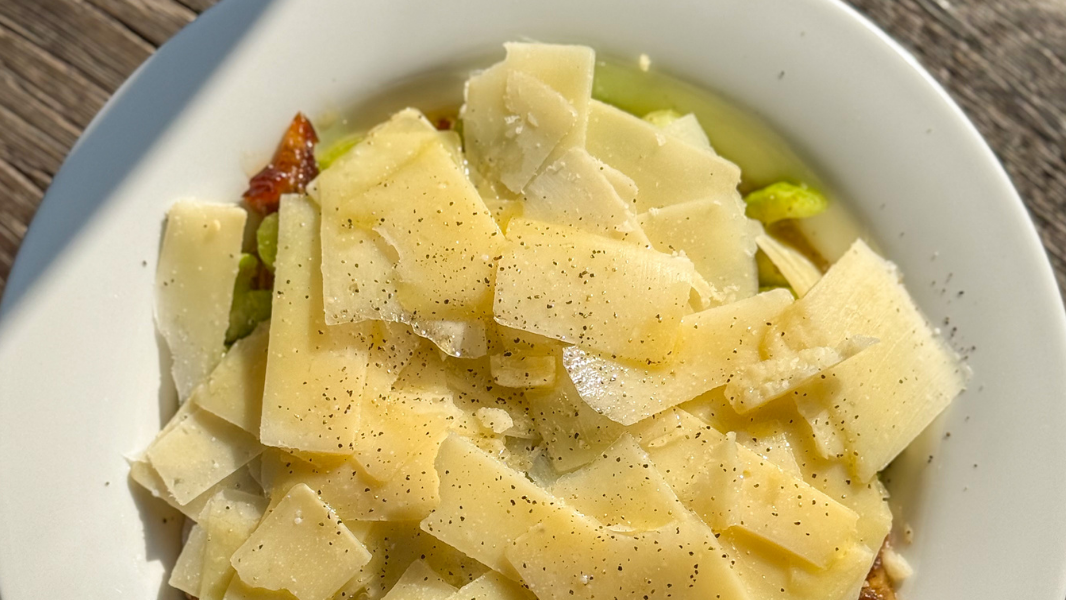
What arrives at the table looks like a plate of cheese. The salad reveals itself as people eat – celery, dates, pecans surfacing one forkful at a time. A last drizzle of olive oil over the top catches the light and pulls the two layers together.


Celery rarely gets to be the main event. It's diced into a mirepoix and cooked until it disappears, or it shows up raw as a vehicle for something else. Cut on a steep bias into short, angled pieces, though, it becomes a different vegetable entirely — pale green, glassy at the edges, with a clean snap and enough surface to hold a dressing. On its own it tastes faintly saline and grassy.
Dates are its natural counterweight. Their caramel sweetness meets the mineral bite of the celery, and pecans bridge the two with butter and a second kind of crunch. The dressing keeps everything bright: lemon juice for acid, a spoonful of date syrup to echo the fruit, and a generous pour of kyoord high-phenolic extra virgin olive oil, whose peppery finish is the sensory signature of its polyphenol content. Because nothing here meets heat, that character arrives on the plate intact.
Then the cheese, which is the whole reason to make this salad for company. Cut the Pecorino Romano into slices as broad and as thin as you can manage and lay them over the surface, overlapping, until the salad disappears underneath.
TIP: Slice the celery no more than an hour ahead and keep it in ice water until you dress it. It crisps the stalks and takes the edge off any bitterness. Dry it thoroughly since a wet stalk won't hold dressing.
Why finish a raw salad with high-phenolic olive oil
Polyphenols are the compounds responsible for the peppery catch at the back of your throat when you taste a robust extra virgin olive oil, and they're sensitive to prolonged heat. A raw salad is one of the simplest ways to get them exactly as they left the bottle. Early research also suggests that the fat in olive oil helps the body absorb fat-soluble vitamins from the vegetables it's dressing, which makes a generous pour a functional choice as much as a flavorful one.
Frequently Asked Questions
Can I make celery and date salad ahead of time?
Yes. The neatest way is to build it in a jar: dressing on the bottom, celery packed above it, dates and pecans on top so they stay dry. Sealed and refrigerated, it holds for up to a day. Just shake and tip it onto a plate when you're ready. If you'd rather assemble on a platter, dress the salad no more than 30 minutes before serving and add the cheese and final drizzle of olive oil just before it goes to the table.
What kind of dates work best?
Medjool dates are soft and caramel-like and chop into sticky, jammy pieces. Deglet Noor are drier and firmer and will give you distinct little nuggets rather than a chewy bite. Either works; use whichever you prefer.
What can I use instead of date syrup?
Honey or maple syrup in the same quantity. Date syrup doubles the fruit flavor already in the salad, so it's the most seamless choice, but the dressing works with any of the three.
Is this salad vegan?
It is without the Pecorino Romano, which is optional. The dressing and the salad base contain no animal products.
What should I serve it with?
It's a natural partner for roast chicken, braised lamb, or anything rich enough to want something bright and crunchy alongside. It also holds up well on a buffet, since the celery stays crisp far longer than leafy greens.
Why use high-phenolic olive oil in a salad?
Polyphenols are heat-sensitive, so an uncooked dish delivers them intact. You'll also taste the difference: the peppery finish of a high-phenolic extra virgin olive oil gives the dressing a backbone that a milder oil can't.

Dr. Limor Goren
Dr. Limor Goren is a cancer researcher, molecular biologist, and the founder of kyoord. Her research focuses on oleocanthal, a powerful anti-inflammatory molecule found in olive oil, and she is the lead author of a peer-reviewed PLOS ONE study on how it acts against cancer cells. Through kyoord, she shares recipes and kitchen tips that make high-phenolic olive oil part of an everyday, food-as-medicine approach to eating well.

Why we recommend "The Governor, Limited Edition"
Looking for a potent high-phenolic olive to give your wellness a boost?
This award-winning early harvest olive oil is known as one of the most exceptional olive oils in the world and has been rigorously tested by scientists for treatment of various diseases, including hypertension, cancer, and Alzheimer’s.
More Recipes
View all-

Honeycrisp Radish Salad with Apple Cider Dijon Vinaigrette
Sweet Honeycrisp apple, sharp radish, and shaved fennel meet goat cheese and toasted walnuts in this 15-minute fall salad. A peppery apple cider Dijon vinaigrette made with high-phenolic extra virgin olive oil ties it all together.
Honeycrisp Radish Salad with Apple Cider Dijon Vinaigrette
Sweet Honeycrisp apple, sharp radish, and shaved fennel meet goat cheese and toasted walnuts in this 15-minute fall salad. A peppery apple cider Dijon vinaigrette made with high-phenolic extra virgin olive oil ties it all together.
-

No-bake Tahini Chocolate Squares (Gluten-free and Vegan)
Flourless, dairy-free, gluten-free, and sweetened with dates. These rich tahini chocolate squares are a no-bake dessert built in layers of sweet, nutty, crunchy, and salty.
No-bake Tahini Chocolate Squares (Gluten-free and Vegan)
Flourless, dairy-free, gluten-free, and sweetened with dates. These rich tahini chocolate squares are a no-bake dessert built in layers of sweet, nutty, crunchy, and salty.
-

Celery and Date Salad with Pecans and Pecorino
This Celery and Date Salad is a 20-minute, no-cook salad of crisp celery, chopped Medjool dates, and chopped pecans, dressed in lemon juice, date syrup, and high-phenolic extra virgin olive oil, and finished with broad slices of Pecorino Romano.
Celery and Date Salad with Pecans and Pecorino
This Celery and Date Salad is a 20-minute, no-cook salad of crisp celery, chopped Medjool dates, and chopped pecans, dressed in lemon juice, date syrup, and high-phenolic extra virgin olive oil, and finished with broad slices of Pecorino Romano.


- Choosing a selection results in a full page refresh.
- Opens in a new window.